Conservation of Hakka Architectures: Meaning of Preservation-cum-Development
- Tsz Yau LAM
- May 19, 2022
- 9 min read

Updated: May 20, 2022
Pun Uk
One step next to Pok Oi Hospital, on the eastern fringe of Yuen Long Newtown, is a one-hundred-year-old mansion hidden underneath the weeds.
The mansion, Pun Uk (the Mansion of the Puns), or the Yum Wah Lo (蔭華廬), was constructed in 1934, by a merchant Pun Kwan-min, to commemorate his father, Pun Yum-wah.
Pun Uk
Pun Kwan-min was a devoted revolutionary, who supported the underground resistance secret society, Tongmenghui led by Dr. Sun Yat-sen during the Xinhai Revolution and funded the construction of Pok Oi Hospital next door.
The mansion also became a shelter for the revolutionists at that time, including Ye Jianying, one of the founding Ten Marshals of the People’s Liberation Army for the new China.

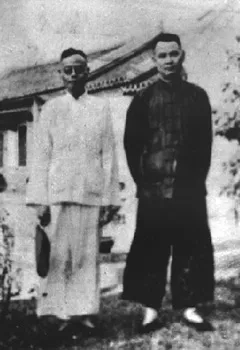

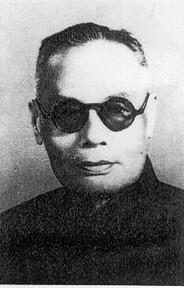
Pun Kwan-min (Photo credit: easyatm.com.tw)
Pun Kwan-min and Ye Jianying (Photo Credit: We to Ask HK 港識多史)
To build Pun Uk, Pun hired an excellent team of traditional craftsmen from his hometown, Meixian (梅縣), which was one of the major Hakkas settlements in northeastern Guangdong Province.
Named after Pun’s father, the mansion follows a symmetrical Meixian two-hall-two-row (tong wang) structure (堂橫屋), with various Fengshui features.
A gable roof of four layers of Hakka pantiles; a half-moon-shaped pond in front of the mansion; a half-moon-shaped woodland at the back; the entrance, the beams, the walls, were richly decorated with carvings, and wall paintings, plastered moldings of auspicious motifs of birds, plants, flowers, animals, and characters.

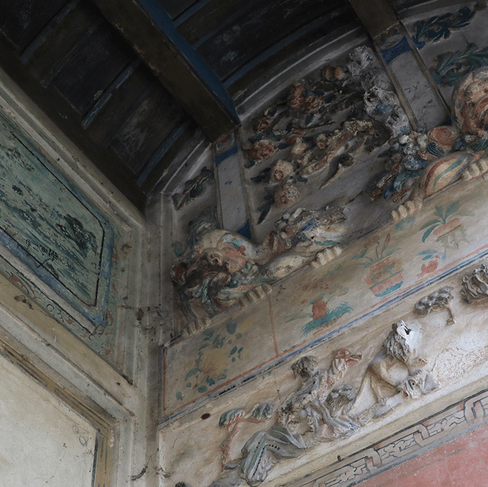


Paintings and Wall Carving found in Pun Uk
(Photo Credit: Architectural Conservation Laboratory, Faculty of Architecture, The University of Hong Kong)
Dr. Gesa Schwantes was the Director of the Architectural Conservation Laboratory under the University of Hong Kong’s Faculty of Architecture, where Schwantes and her students conducted research and analysis on the conservation of Pun Uk in 2019.
Schwantes recalled when she was invited by a conservation architect to work on an investigation report on Pun Uk. “She brought me to Pun Uk, and I asked her if I could bring my students to the building as it was so interesting.”
“For this building, it is a great example for the students, as it has every problem that you can have [when conserving historical buildings],” she said. “It is extremely wet, it has problems with the drainage, and so many issues with the plaster detaching.”
Schwantes said that humidity is the key factor in the deterioration of the construction materials, but the drainage problem of the site has made Pun Uk so humid that it is in a dangerous condition.
“There used to be a pond in front of the building, the water in the house would drain into the pond and drain away. But everything was stuck as there were so many plants and unclean drains. When there is heavy rain, the water [level] would reach the doorstep.” she added.

Dr. Gesa Schwantes (Left). (Photo Credit: Architectural Conservation Laboratory, Faculty of Architecture, The University of Hong Kong)
After Schwantes got permission to have on-site lectures with the students at Pun Uk, she applied to HKU to fund a small research project, including an exhibition where students would showcase their observations and findings to guests.
But there is still no formal conservation of Pun Uk -- Schwantes’s investigation on Pun Uk stopped at an initial stage after the exhibition, due to a lack of funding. Schwantes left the university in 2020 and is now an Associate Professor at Shanghai University.
“The architect who contacted me for the investigation report opted out in the middle of the project, as she said the owner was not paying anymore,” she said. “At least by the time I left [Hong Kong], nothing [had] been done at Pun Uk.”
Although Pun Uk was graded as a Grade I historical building in 1985 (and was officially listed in 2010), the hundred-year-old mansion had been abandoned for decades and faced possible demolition several times.
According to the Town Planning Board’s record, even though the site has a rich historical value, it was nearly turned into a residential project various times in 1994 and 1995 respectively -- yet the applications were banned by the Town Planning Board at the time for the reason “the proposed development will affect the existing Grade I historical building which is of outstanding historical and architectural merits”.
The mansion was later proposed to be preserved with residential buildings on the side in 1996. This time, the proposal was approved by the Board, however, construction never began
According to the Land Registry, the Pun family sold the mansion in 1994. After it had been transferred to various developers, it was bought by Joyous Cheer Limited, for HK$74 million in 2007. The company is a subsidiary of the CNT Group, which is controlled by Philip Tsui Ho-chuen and Terry Tsui Yam-tong, respectively the son and brother of the deceased tycoon Tsui Tsin-tong.
“I remember that the owner wanted to turn Pun Uk into a Hakka museum, and a columbarium,” Schwantes said.
In 2010, the group applied to the Town Planning Board to build up 20,000 niches at the mansion. It had once brought controversy to the city, as the locals worried if the proposal would add extra traffic burden to Yuen Long; while the Board had rejected the application as no plans of conservation were mentioned.
Throwing back to October 2021, the group proposed to the Board again with a new plan. This time, not only the mansion would be conserved, there would be an elderly care complex surrounding the mansion, adjacent to the Pok Oi Hospital’s Jockey Club Care and Attention Home.

Landscape master plan of the proposed development at Pun Uk (Photo Credit: Town Planning Board)
According to documents on the Town Planning Board’s website, the proposed development was appreciated by the Antiquities and Monuments Office for the “intention to preserve this Grade l historic building in-situ.” Meanwhile, there will be guided tours and educational programs provided to the public free of charge.
However, the proposal was postponed, again.
“The Town Planning Board decided to defer a decision on the application as requested by the Planning Department given the situation of COVID-19. The Committee agreed that the application should be submitted for its consideration as soon as practicable after the fieldwork was resumed and the required background information of the application site and comments from relevant government departments could be made available,” the Board said in an email response, while the timetable for discussion is unfixed.
Pun Uk shared some common features of Southern China Hakka architectures, including the four-layered pantile roof, although it might be neglected since part of the roof had collapsed, Schwantes said.
According to Schwantes’s research on Pun Uk, the roof adopted four layers of tiles: “top layer covered in grey Hakka tiles, second layer covered in grey pantiles laid in a zig-zag form, the third layer is covered in red pantiles, and the bottom layer is covered in grey pantiles laid in a butt joint pattern”.

The roof at Pun Uk.
Since part of the outer wall collapsed, where Schwantes got a chance to see the cross-section -- Hakka grey-green pantiles were adopted, which was also widely used in other Hakka settlements in Hong Kong such as Lai Chi Wo.
“There are decorations on the plasters or inside [the mansion], and the painted decoration, wood carvings and wooden doors inside,” Schwantes said. “So the main entrance is quite highly decorated. There were two lions [at the entrance], and one was actually stolen shortly before I started the project” -- just a day before her first visit to Pun Uk.

The missing rock lion carving at the entrance of Pun Uk.
Despite Pun Uk sharing similarities with Southern Chinese Hakka houses, it has its unique historical value and it was originally designed according to Fengshui principles, such as the symmetric two-hall-two-roll structure, the half-moon-shaped pond, and the bamboo forest behind the mansion -- Take a virtual tour to Pun Uk made by Schwantes and her students.
With Schwantes’ expertise in historic preservation and conservation, she had actively joined other conservation projects back in Hong Kong, including the News Expo in Central.
Pun Uk was Schwantes’ first and only Hakka conservation project. wondered if there is a need for society to grant an aim on conservation.
“I found a lot of conservation projects in Hong Kong, [that] they need to be a museum afterward, but somethings it’s okay to just conserve the building and not make it into a museum,” she said. “It makes everything over the top sometimes.”
Diversity is needed, she added, as she felt the government has a lack of flexibility when bringing diversity into conservation.
“I feel like a lot of the conservation is pushed to be a clean-up,” she said. “On the one moment, you see the building is gone the next morning and nobody cares. It is not easy.”
Lai Chi Wo
Near Sha Tau Kok, the city’s northernmost town, there is another Hakka settlement that is revitalized after being idle for more than 30 years -- Lai Chi Wo.
The 300-year-old Lai Chi Wo is one of the largest remaining traditional Hakka villages in Hong Kong. It has a long history of paddy farming. Since the 1950s, villagers began to move out to the urban areas or European countries to earn a
living. In the late 1970s, the road to the village was blocked after a substantial part of the surrounding woodland was designated as part of the Plover Cove Country Park. With no foreseeable options for the village, the last villager moved out in the 1990s.
It is now reborn as an in-situ Hakka culture experience village, as The Countryside Foundation has been engaging in restoring the Hakka traditions at Lai Chi Wo since 2013. After a recultivation project brought out jointly with the University of Hong Kong in 2013, the foundation is taking another step to conserve Hakka architecture as accommodation for tourists.

Lai Chi Wo Village (Photo credit: Hong Kong Tourism Board)
The Traditional Craftsmanship and Cultural Inheritance in Lai Chi Wo project, led by the Foundation, and funded by the Jockey Club and Environmental Protection Department, had been conserving some 25 Hakka houses since 2021. Up to now, 9 of them have been completed, project director David Au Chi-wai said.

David Au Chi-wai, Project Director at Countryside Foundation
“Lai Chi Wo is one of the few large-scaled Hakka walled villages in Hong Kong and Southern China, where its originality or authenticity is well preserved,” Au said.
Among over 200 houses, although villagers had once brought out constructions at some houses, Au said most of them were well kept with the architectural features from 100 years ago.
Au said the project would finish by the end of this year when the conservation work winds up. A total of 15 Hakka houses will be opened to the public this summer as guesthouses, according to a media report in May.
Meanwhile, in accordance with the ongoing Lai Chi Wo Hakka Life Experience Project in the village, these guest houses would also provide workshops, to give hands-on experience to the public on Hakka culture, such as farming, making Hakka-style stuffed tea cake made with sticky rice flour and more.
He recalled some typical characteristics of the houses in the village -- including the three-layered monk and nun gable roof, and the rammed earth walls (夯土牆).
Supported by wooden crossbeams, pantiles are put on the framework, and the top linking tiles are the monk tiles (facing upward) and the lower layer are the nun tiles (facing downward). Not a drop of glue or ceramic cement is used to fix the tiles.
A tile roof in such a structure can resist strong wind and heavy rain. Material scientists had resolved the reason behind the unglued tile roof, as the inclination of the roof is less than 27 degrees.
Au regarded the pantile roof as an essential element of the houses, and he felt sad as some villagers had replaced the pantile roof with iron sheets.

Gable roof with pantiles placed in monk and nun style
Outer walls at houses in Lai Chi Wo could be seen using compacted natural raw materials such as earth, chalk, rock, and even animal feces and blood. These rammed earth walls were built by the villagers 100 years ago, with materials they had around. This technique can also be seen in other Hakka settlements in Southern China.
Au added that these rammed earth walls had great resilience compared to concrete walls, yet these walls collapsed or were exposed to air after years of erosion of water.
The greatest challenge Au and his team faced were to strike a balance between complying with the existing building, ventilation, and fire control regulations while conserving the characteristics of the houses.
“It would be rather simple if we preserve the building exactly like how the ancient people did,” he said. “But only by complying with those regulations we can purchase insurance and get the guesthouse license.”

Exposed rammed earth walls at Lai Chi Wo
Although Lai Chi Wo shared the rich history of the Hakkas in Hong Kong, the whole settlement did not fall into any of the historical building grading categories under the Antiquities Advisory Board.
There were media reports regarding the Hakka guesthouses, but Au said this wasn’t the Foundation’s aim to promote tourism in Lai Chi Wo.
“Since this project is funded by the Jockey Club, we have to comply with some of its criteria to launch the project with the public interest,” he said. “So we turned these houses to guesthouses,” and so for the cultural experiential activities.
Despite the project being funded by the Environmental Protection Department in promoting the traditional Hakka craftsmanship, Au felt that the government still held a passive view of the project, where he described the project as a “lab rat”. “Even the government is waiting for our outcomes, and see if we can share our own experience with other villages,” he said.
Au said the Foundation was going to launch the weekday waterbus service in April, but the plan paused due to the fifth wave of the COVID-19 pandemic, meanwhile, the Foundation is planning in-depth local tours on the history of Lai Chi Wo, to attract more visitors experiencing the local Hakka culture.

Comments